Method
How every number on this site is made, checked and limited. Values on this page are read from the same data files the product uses.
1. Data
SPHEREx level-2 images from the DR1 and QR3 releases (l2b-v27), read straight from the public S3 bucket of NASA/IRSA. The exposure index has 809 593 exposures for detectors D4–D6 and 1 630 148 S3 keys; D1–D3 see the same sky as their pair D4–D6, shifted by the dichroic.
Nothing is simulated: every image, spectrum and measurement comes from these files, from Gaia DR3 and SIMBAD for positions, or from JPL Horizons for ephemerides.
2. SPHEREx as an observer
Six H2RG detectors with 6.15″ pixels share a linear variable filter: each row of a detector sees a slightly different wavelength, so one exposure samples a narrow band per row, and the 102 channels together cover 0.75–4.99 µm. Each exposure lasts 113.58 s.
| Detector | Wavelength (µm) | Channels | Resolving power R |
|---|---|---|---|
| D1 | 0.74–1.12 | 17 | 37–42 |
| D2 | 1.10–1.65 | 17 | 41–43 |
| D3 | 1.64–2.44 | 17 | 40–42 |
| D4 | 2.42–3.83 | 17 | 34–42 |
| D5 | 3.81–4.43 | 17 | 108–117 |
| D6 | 4.42–5.01 | 17 | 125–135 |
3. Wavelength of every pixel
Each pixel's wavelength comes from the full-resolution spectral WCS (cal-swcs-v5-2026-191), never subsampled: subsampling by 4 pixels leaves the 99th percentile within 1 nm but hides jumps of hundreds of nanometres at detector edges. Pixels closer than 20 px to an edge are excluded from spectra.
The v5 calibration moves D5 and D6 by +6.3 nm with respect to the previous one, and leaves D1–D4 unchanged. Independently, our comet census had measured that the CO₂ band of D5 fell about 3.7 ± 0.9 nm short of its laboratory wavelength: the new calibration corrects it in the same direction. We use v5 as published and keep the band shift free in every band fit.
| Detector | Shift v27 − v20 (nm) |
|---|---|
| D1 | 0.0 |
| D2 | 0.0 |
| D3 | 0.0 |
| D4 | 0.0 |
| D5 | +6.3 |
| D6 | +6.3 |
4. Diff λ: the same sky at the same color
Because every row sees another wavelength, subtracting two visits leaves a residue on almost every star. Diff λ instead builds, for each frame, a reference of the static sky at that frame's wavelength: it takes up to 8 frames from other visits whose wavelength is within 3 channel widths, and, per pixel, fits a line in wavelength (3σ clipped) when the references surround the frame's wavelength, or takes their median when they do not (no extrapolation). A frame needs at least 3 references, otherwise Diff λ is reported unavailable.
The difference is frame minus reference. What did not change cancels; what moved appears positive where it is and negative where it was; σ is 1.4826 × the median absolute deviation and sets the ±5σ color scale.
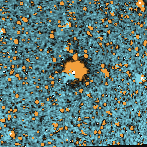
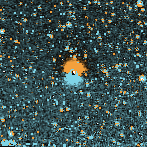
Measured in the research notes (not re-run here): χ²ᵣ of comet band fits fell from 104 to 6.5 for 24P and from 440 to 32 for C/2024 J3 when the sky was subtracted this way.
5. Photometry of one pixel
Spectra come from a forced fit of the exposure's sampled effective PSF (radius 4 px, free background), with the official quality mask. The mask rejects SUR_ERROR, NONFUNC, DICHROIC, MISSING_DATA, HOT, COLD, NONLINEAR, PERSIST, BLOOM, SNOWBALL, HALO, SATELLITE_HALO. Saturated (OVERFLOW) pixels are not masked, as the SPHEREx team recommends; they are flagged instead.
No aperture correction is applied: SPHEREx's absolute gain was calibrated with ePSF photometry, so the sampled ePSF flux already is the calibrated flux. An early version that applied one counted the PSF wings twice and put W2 10% high. The error of each point is σ² plus a 3% systematic of the flux, in quadrature.
Check against 2MASS and WISE: 41 isolated stars in the fields CDFS, COSMOS, NEP. SPHEREx flux divided by catalogue flux, with the scatter between stars:
| Band | Stars | Ratio |
|---|---|---|
| J | 38 | 0.982 ± 0.020 |
| H | 39 | 1.008 ± 0.038 |
| Ks | 29 | 1.011 ± 0.033 |
| W1 | 41 | 0.972 ± 0.014 |
| W2 | 41 | 0.996 ± 0.014 |
The mean of the five bands is 0.994, and every band lies between 0.972 and 1.011. We quote the whole range, about ±3%, not a single number: an earlier −3.5% in one field did not repeat in the other two.
6. Comet gas
Gas in comets is measured in sky-subtracted spectra with a physical model of the CO₂ ν₃ band (P and R branches, even rotational levels, rotational temperature and a free wavelength shift). CO and H₂O use their own windows: CO in D6 at 4.60–4.74 µm, H₂O in D4 at 2.50–2.86 µm, CO₂ in D5 at 3.85–4.42 µm.
The production rate Q comes from a Haser parent model in an aperture of 3 px with a background ring of 40–55 px. In the regime of these data Q is nearly proportional to the outflow speed and barely depends on the lifetime, so speed dominates the systematic: assuming 0.50 instead of 0.85 r_h^−0.5 km/s lowers Q by about 40%.
| Constant | Value at 1 au |
|---|---|
| g-factor (fluorescence) CO₂ | 2.86 × 10⁻³ s⁻¹ |
| g-factor (fluorescence) CO | 2.46 × 10⁻⁴ s⁻¹ |
| g-factor (fluorescence) H₂O | 4.24 × 10⁻⁴ s⁻¹ |
| Photodissociation lifetime CO₂ | 5.00 × 10⁵ s (3.10 × 10⁵ s) |
| Photodissociation lifetime CO | 1.30 × 10⁶ s |
| Photodissociation lifetime H₂O | 8.30 × 10⁴ s |
Uncertainty: a Monte Carlo of 4 000 draws over flux (statistical and profile spread), 5% calibration, 5% g-factor, lognormal lifetime (0.3) and lognormal speed (0.2); we report the 16, 50 and 84 percentiles.
Detection requires S/N ≥ 5 and χ²ᵣ < 50. A comet with a band but a poor fit is shown as “with systematics”; one with 3 ≤ S/N < 5 as “marginal”. The current statuses are 17 detected, 2 with systematics, 1 marginal and 0 not detected among 20 comets.
7. Validation
Photometry is checked against 2MASS and WISE (section 5). Comet results are compared with published values on the atlas page; a value inside the published range is consistent with it, not an independent confirmation.
Asteroid sizes use the NEATM thermal model with η = 1.48 ± 0.44. Against NEOWISE in 50 near-Earth objects the out-of-sample ratio SPHEREx/NEOWISE spans 0.67–1.36 (16–84%), about −33%/+36%. The median of 1.02 is 1 by construction, because η is fitted to make it so: it is not an accuracy. Every published diameter carries its interval, its evidence tier and a 35% systematic floor.
Only 5 of the 50 validation pairs retain their absolute NEOWISE diameter; the page states it and does not fill in the rest.
8. Null tests and injections
On null spectra (apertures placed where no comet is) the detection rule gave 0 false positives out of 79. This figure comes from the research notes and was not re-run for this build.
Pending: a published injection–recovery test of the comet pipeline. Until it exists, no completeness or false-alarm rate is claimed.
9. Limits
- It is a census by pass, not real time: each object is revisited a few times a year and public data lag by weeks.
- Gas needs nearby or very productive objects: the band flux scales as Q r_h⁻² Δ⁻². Beyond about 10 au the Q is not trusted.
- The wavelength of D5 and D6 depends on the spectral calibration version; the shift stays free in every fit.
- A professional multi-comet catalogue exists (spherex-comet by bumhooLIM, 68 comets, results not public). We do not claim a first census; our contribution is a public, reproducible tool with its checks.
- Cold-cache stacks take about 5–6 s; the precomputed targets load instantly.
10. Reproducibility
The record below is generated from the product's own files at commit 06a20ef. Source code, pipelines and tests are in the repository.
| Item | Value |
|---|---|
| Data release and L2 version | DR1 + QR3 · l2b-v27 |
| Spectral WCS | cal-swcs-v5-2026-191 |
| Exposures indexed (D4–D6) | 809 593 |
| Precomputed stacks | 38 |
| Record generated | 2026-11-14T19:20Z |