BREATHING COMETS

102 colors of infrared light

Every SPHEREx exposure sees the sky through a strip of filters: 0.75 to 4.99 µm, split into channels. Taller bars resolve finer color.

Hover a bar to read its channel.

Bar height: resolving power R. Dashed bars: frames the DR1 all-sky cube leaves blank (dichroic).

§2

A rainbow on a chip.

SPHEREx has no filter wheel. A linear variable filter sits on each detector, so every row of pixels sees a slightly different wavelength. A star is measured in many colors as the telescope sweeps past it.

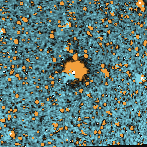
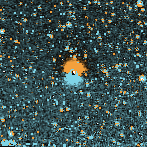
The catch: on two visits the same star lands on different rows, so it is seen in a different color (3.74 µm versus 2.46 µm here). Subtract the two frames and almost every star leaves a residue.

Diff λ compares each frame with the static sky at the same wavelength, built from other visits. What survives is what really changed — here, the star that moved.

Diff λ reference: static sky at the frame's wavelength from 5 other frames · both panels share one ±5σ color scale

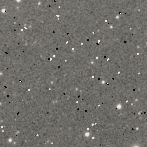
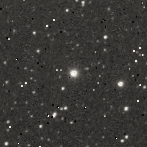
Raw subtraction of two SPHEREx frames at different wavelengths: residues at almost every star Diff λ of the same frame: only the moving Barnard's Star leaves a positive–negative pair
Raw B − A D4 2.46 µm (2026-09-02) − 3.74 µm (2026-03-11) Diff λ D4 2.46 µm · 2026-09-02 · obs 2026W36_1A_0510_1 SPHEREx: NASA/JPL-Caltech/IRSA (DR1 + QR3, L2 l2b-v27)
−5σ 0 +5σ saturated σ = 0.020 MJy/sr

§3

What the sky is made of.

Each SPHEREx color is a slice of a spectrum. Molecules absorb or glow at their own wavelengths: water, methane, carbon dioxide and carbon monoxide all leave fingerprints between 1 and 5 µm, and hydrogen marks itself in sharp lines.

This is a real SPHEREx spectrum of a pair of brown dwarfs, separated from their neighbors with Gaia. Pick a band to see where it shows up.

Band definitions: §12.3 of the build guide · shaded widths are the regions annotated, not fits

12345λ (µm)0mJy
Loading… SPHEREx: NASA/JPL-Caltech/IRSA

Select a band to learn which object in this set shows it.

§4

Comets breathe.

Near the Sun, a comet's ices turn to gas. In SPHEREx frames the dust glows as a smooth continuum; subtract it and the gas remains, brightest at the carbon dioxide band.

From that glow we estimate how many molecules leave the nucleus each second, always with an uncertainty range and a stated caveat.

Interstellar comet 3I/ATLAS is our validation case: its numbers are compared with published measurements in §5.

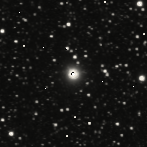
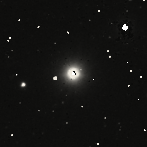
SPHEREx plate of 3I/ATLAS
3I/ATLAS · SPHEREx · 4.14 µm · MJD 60888.67 · obs 2025W31_2A_0219_1 SPHEREx: NASA/JPL-Caltech/IRSA (DR1 + QR3, L2 l2b-v27) · Ephemeris: NASA/JPL Horizons (SPHEREx observer)

Q(CO₂), August 2025

1.17 × 10²⁷ s⁻¹

range 8.60 × 10²⁶ – 1.38 × 10²⁷

Statistical error ±3.0e+25; χ²ᵣ 27.5. The 16–84% range comes from the research notes and Q scales with the assumed outflow speed (about −40% for 0.50 instead of 0.85 r_h^−0.5 km/s).

Research fit of the CO₂ ν₃ band (research/11_band_physical.py), reproduced 2026-11-14

Q(CO₂), December 2025
3.42 × 10²⁷ s⁻¹ (range 2.78 × 10²⁷ – 4.18 × 10²⁷)
Band present (S/N 41.1) but the model fits poorly (χ²ᵣ 185): Q is not trusted at its quoted precision.
Comet census (co2_census_physical.csv)

§5

Measured, then checked.

A number is only useful if you know how far to trust it. Every SPHEREx measurement here is compared with an independent reference before it is shown.

Comet gas production
SpeciesSPHEREx (this work)Published rangeCheck
3I/ATLAS · CO₂ · 2025-081.17 × 10²⁷ s⁻¹9.40 × 10²⁶–1.60 × 10²⁷within range
χ²ᵣ 27.5. Consistent with the published range; not an independent confirmation. Lisse et al. 2025, RNAAS, arXiv:2508.15469 (0.94e27, preliminary); Lisse et al. 2026, ApJL 1000, L52, arXiv:2512.07318 (1.6e27 +/- 0.16e27)
29P/Schwassmann-Wachmann · CO · 2025-124.50 × 10²⁸ s⁻¹2.90 × 10²⁸–5.60 × 10²⁸within range
χ²ᵣ 127.3. Consistent with the published range; not an independent confirmation. Bockelee-Morvan et al. 2022 (IRAM, 2.9-5.6e28); quiescent 1.8e28 (Festou et al. 2001)
Photometry against 2MASS and WISE · 41 stars · fields CDFS, COSMOS, NEP
BandCatalogueStarsSPHEREx / catalogue
J2MASS380.982 ± 0.020
H2MASS391.008 ± 0.038
Ks2MASS291.011 ± 0.033
W1WISE410.972 ± 0.014
W2WISE410.996 ± 0.014

SPHEREx flux divided by catalogue flux, per band, ± σ. Mean of the bands 0.994; band ratios span 0.972–1.011. Method: flux = sampled-ePSF forced fit (R=4 px, free background), NO aperture correction; err^2 = sigma^2 + (0.03 F)^2; official photometry mask

§6

Five places to start.

The five objects of the challenge, each with a real SPHEREx plate and field notes. Every number sits next to its reference and its caveat.

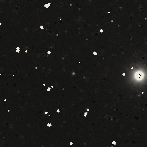
  1. SPHEREx plate of the field of Barnard's Star, detector D4, 2.71 µm, north up
    D4 · 2.71 µm · 2025-08-28 obs 2025W35_1A_0658_4

    01

    Barnard's Star

    The fastest star across our sky.

    Proper motion (SPHEREx)
    10.6 ± 0.4″/yr
    Gaia 10.39″/yr
    Parallax
    not measurable (saturated core)
    547 mas

    Caveat:formal error ±0.10″/yr; ±0.4 reflects frame systematics (saturated core, 3 useful visits)

    Explore Barnard's Star
  2. SPHEREx plate of the field of Epsilon Indi B (Ba+Bb), detector D6, 4.85 µm, north up
    D6 · 4.85 µm · 2025-10-06 obs 2025W41_1A_0052_1

    02

    Epsilon Indi B (Ba+Bb)

    A brown dwarf pair, with methane in its spectrum.

    Proper motion (SPHEREx)
    4.75 ± 0.04″/yr
    Gaia DR3 4.68″/yr
    Parallax (differential vs 4 Gaia field stars)
    271 ± 20 mas
    Gaia DR3 270.7 mas (ε Ind A: 274.8 mas)
    Methane at 3.3 µm
    5.4× fainter than the 4.0 µm peak
    T1+T6 dwarfs

    Caveat:error from per-visit bootstrap (9 visits); dropping one control star gives 277–294 mas

    Explore Epsilon Indi B (Ba+Bb)
  3. SPHEREx plate of the field of WISE 0855−0714, detector D6, 4.82 µm, north up
    D6 · 4.82 µm · 2026-04-26 obs 2026W17_2A_0591_1

    03

    WISE 0855−0714

    The coldest known object outside the Solar System.

    Below 3.8 µm
    ≈ 0 (deblended from Gaia star at 6.8″)
    J ≈ 25
    Synthetic W2 (real W2 response curve)
    0.45 ± 0.02 mJy
    published W2 ≈ 13.9 mag (0.48 mJy); CatWISE2020 13.82 (0.51 mJy)

    Caveat:14% of the W2 band lies beyond SPHEREx's 5.0 µm limit; the AllWISE catalogue value (13.70 mag, 0.57 mJy) is blended at the 2010 position

    Explore WISE 0855−0714
  4. SPHEREx plate of the field of RW Aurigae, detector D6, 4.80 µm, north up
    D6 · 4.80 µm · 2026-02-21 obs 2026W08_2A_0361_1

    04

    RW Aurigae

    A young star dimmed and brightened by its disk.

    2025-09 → 2026-09
    optical ×1.8 · 4–5 µm ×0.5 (anti-correlated)
    inner-disk hot dust
    SPLICES
    ice target (Class II YSO)
    IRSA

    Caveat:three epochs only

    Explore RW Aurigae
  5. SPHEREx plate of the field of R Draconis, detector D6, 4.68 µm, north up
    D6 · 4.68 µm · 2026-04-11 obs 2026W15_2A_0483_3

    05

    R Draconis

    A pulsating red giant.

    Variability timescale (3.8–5.0 µm, wing photometry)
    ≈ 229 d (225–241)
    catalogued period 245.6 d
    Peak-to-peak range (5–95%)
    2.0 mag (0.9 µm) → 0.7 mag (4.4 µm)
    Mira

    Caveat:only 1.9 cycles observed: consistent with the catalogued period, not an independent measurement (1.1–2.4 µm gives 236 d, 230–519)

    Explore R Draconis

Scroll sideways for all five →

Data

  • SPHEREx: NASA/JPL-Caltech/IRSA (DR1 + QR3, L2 l2b-v27)
  • Gaia DR3: ESA/Gaia/DPAC
  • Positions: SIMBAD (CDS, Harvard mirror)

SPHEREx data are NASA mission data distributed by IRSA. Breathing Comets is an independent Space Apps project, not a NASA product.

Use of AI

AI tools assisted parts of this project; their use is declared in the “Use of AI” section of our Space Apps submission.

Landing plates

Rendered 2026-11-14T17:10Z by pipelines/landing_media.py from the published target packages: common stretch per stack, north up, saturation in white, pixels not resampled.

BREATHING COMETS · NASA SPACE APPS 2026

enes